Empowering Smarter Cities with AIoT: Revolutionizing Urban Living (2)

In an era marked by swift technological progress, the fusion of Artificial Intelligence (AI) and the Internet of Things (IoT) has opened doors to the development of more intelligent urban environments. As we explained some in our previous post, in this second edition we add some other very important aspects aswell.

Efficient Waste Management

Waste management in urban areas is a significant challenge. AIoT-powered smart waste bins equipped with sensors can monitor their fill levels, trigger notifications to waste management services and optimize collection routes. The city of Santander in Spain has implemented a smart waste management system that employs IoT sensors in waste bins. These sensors monitor fill levels and transmit data to a central system, where AI algorithms analyze the information. By predicting fill times and optimizing collection routes, the city minimizes unnecessary pickups, reduces operational costs, and promotes environmental sustainability. Read more

Data-Driven Decision Making

The abundance of data generated by IoT devices in smart cities provides valuable insights for urban planners and policymakers. AI algorithms process this vast amount of data so that city officials can gain a comprehensive understanding of various aspects, including traffic patterns, energy consumption, and citizen behavior.

For instance, the city of Helsinki (Finland) utilizes AIoT technologies for data-driven urban planning. The city integrates data from various sources (i.e., IoT sensors, public transportation systems, and environmental monitoring devices) to gain insights into traffic patterns, energy consumption, and citizen behavior. These insights inform decision-making processes, enabling the city to optimize services, plan infrastructure developments, and enhance overall quality of life for its residents. Read more

Community Engagement and Citizen Well-being

AIoT not only focuses on infrastructure and efficiency but also plays a vital role in enhancing citizen engagement and well-being. In the realm of smart cities, the integration of Artificial Intelligence and the Internet of Things (AIoT) has revolutionized the way citizens interact with their local governments and services, making participation seamless and instantaneous.

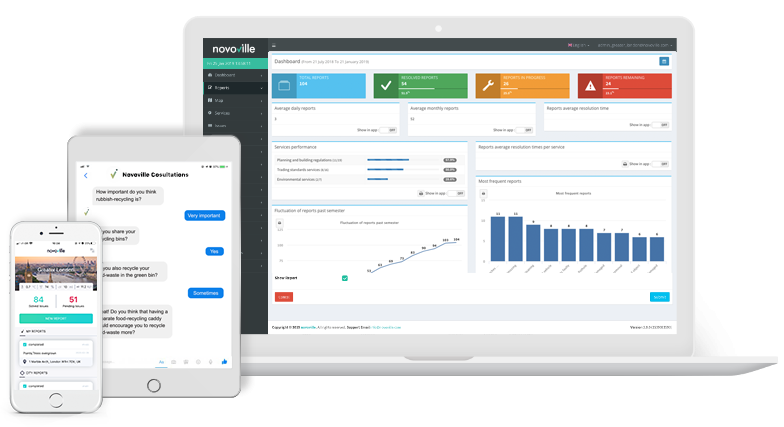
In Athens, Greece, the Novoville application empowers citizens with the ability to conveniently report issues, request services, express their opinions, and make payments with just a simple click. Through user-friendly applications and smart devices, individuals can promptly notify local authorities about concerns like potholes, streetlight outages, or sanitation issues. Additionally, the application provides secure and easy-to-use interfaces for making payments.Read more

In conclusion, the synergy between Artificial Intelligence and the Internet of Things is reshaping urban landscapes worldwide. The implementation of AIoT solutions is vital for building smarter cities that are sustainable, efficient, and citizen centric. As cities continue to grow and face new challenges, embracing AIoT technologies is not just a choice but a necessity to create a better, more connected future for everyone. By harnessing the power of AIoT, cities can transform into vibrant, sustainable, and intelligent hubs that enhance the lives of their citizens while preserving the environment for generations to come.
Read More

Entersoft S.A

Entersoft S.A. is a leading business software and services provider in South East Europe and the Middle East.

It offers a comprehensive and integrated business software suite with ERP, CRM, HRM, Retail, WMS, e-Invoicing, Mobile, e-Commerce and B.I. applications. The suite is developed on the latest Microsoft .NET® technology and is available for on-premise or on cloud installation, while can be used either as a licensed product or as Software as a Service (SaaS).

Entersoft has been growing impressively, steadily enlarging its prestigious clientele in almost all business sectors and verticals that trust their daily operations and strategic decisions on Entersoft’s innovative products and solutions. The company targets small, medium and large enterprises with products and vertical solutions that provide added value to its customers, means to amplify their competitiveness, enhance their internal and external communication with their audiences and empower their export plans and activities. Moreover, offers specialized vertical solutions for niche markets, such as transport companies, fuel refill stations, ship maintenance for the maritime sector, private education institutes as well as special public sector ERP projects.

The company is listed in the Athens Stock Exchange, owns subsidiaries in Bulgaria, Romania and the Greek companies Wedia , CGSoft and smartCV. It exports to 40 countries through certified partners. Entersoft cooperates with Certified Partners who ensure quality support and implementation capabilities to its customers.

Within NEMO, Entersoftleads the Smart Farming pilot, validating the NEMO meta-OS enhancements in 2 use cases involving aerial and terrestrial biospraying through autonomous drones and robots, respectively. Entersoft also contributes to developing cross-cutting meta-OS components addressing compliance to data security and privacy requirements across the continuum.

Read More

NEMO Project will be present in the event “Giving Energy an Edge”

Tomorrow, 10th of November, an online webinar will be held with the title “Giving Energy an Edge: Showcasing the Edge to Cloud Continuum in Energy” from 10am to 1.20pm. During the event NEMO project will be explained through the Open Calls.

This is an excellent opportunity for all actors of the energy industry, specially researchers, SME’s, Start-ups, developers, or energy companies. During the event you will learn the latest insights of the most transformative use cases at the crossroads of energy and Cloud-Edge-IoT computing, but also will be able to explore funding and support opportunities for your energy projects.

Also you will be able to:

  • Engage in open call applications
  • Establish connections with key stakeholders in the European tech ecosystem
  • Learn how emerging edge technologies can benefit your business and understand the opportunities for transitioning to a CEI approach
  • Explore potential energy-centred applications and development of new products and services
  • Identify partners, customers, and alternative architectures within the Cloud Continuum in energy

At 11.20 there will be a lecture on Open Call Oportunities as part of the agenda of the online event. Our colleague Dimitrios Skias, from our partner INTRA, will be explaining NEMO Project and our 1st Open Calls, whose deadline for applications ends on November, 30th.

Check out the rest of the event’s agenda here. (https://eucloudedgeiot.eu/event/giving-energy-edge-showcase/)

Read More

Empowering Smarter Cities with AIoT: Revolutionizing Urban Living (1)

In the age of rapid technological advancement, the convergence of Artificial Intelligence (AI) and the Internet of Things (IoT) has paved the way for creating smarter cities. AIoT, the fusion of these two groundbreaking technologies, has the potential to transform urban living by enhancing efficiency, sustainability, and overall quality of life. As our world becomes increasingly interconnected, the implementation of AIoT solutions is essential for addressing the complex challenges faced by modern cities.

Let’s delve into the ways AIoT is empowering smarter cities and revolutionizing urban environments, providing some interesting showcases:

Intelligent Infrastructure

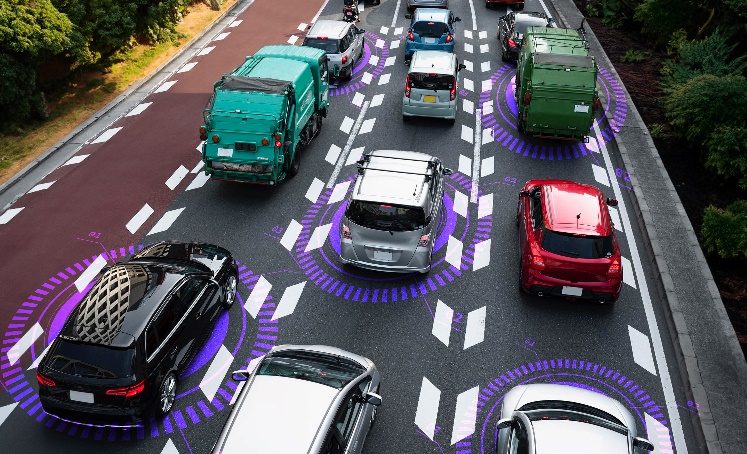
AIoT enables the development of intelligent infrastructure, wherein various urban elements such as transportation systems, energy grids, and public services are interconnected and optimized for efficiency. Smart traffic management systems, for instance, utilize AI algorithms to analyze real-time traffic data from IoT sensors, easing congestion and reducing commute times.

For example, in Germany Siemens has developed an AI-based edge device called the “SPaT Box” (signal phase and timing box) that can predict traffic light phases without any knowledge of the underlying signal phase diagram. This integration enables real-time analysis of traffic flow, allowing for dynamic adjustments to traffic signals and lane management. By optimizing traffic patterns, the city reduces congestion, decreases travel times, and enhances overall mobility for its residents. Read more

Sustainable Energy Management

One of the critical aspects of building smarter cities is sustainable energy management. AIoT applications facilitate the integration of renewable energy sources into existing power grids. AI algorithms analyze consumption patterns and adjust energy distribution accordingly, ensuring a balance between supply and demand. Denmark is one of the pioneers in the implementation of smart grid systems that utilize AIoT technology to manage energy distribution efficiently. By integrating renewable energy sources like wind and solar power into the grid, AI algorithms analyze consumption patterns and adjust energy distribution in real time. This intelligent management ensures a stable energy supply while maximizing the use of renewable sources, contributing to the city’s sustainability goals. Read more

Enhanced Public Safety

AIoT solutions bolster public safety efforts by providing real-time data analysis and predictive capabilities. Smart surveillance systems equipped with AI algorithms can identify unusual patterns or potential security threats, enabling law enforcement agencies to respond promptly.

London’s Metropolitan Police Service has deployed an extensive network of surveillance cameras equipped with AI capabilities, using facial recognition technology and AI algorithms to identify and track individuals of interest in real time. Read more

Read More

Foundation of the Hellenic World (FHW)

The Foundation of the Hellenic World (FHW), is a privately funded not-for-profit cultural institution based in Athens. Its foundation was ratified in 1993 by unanimous vote of the Hellenic Parliament.

FHW’s mission is the preservation of Hellenic history and tradition, the creation of an awareness of the universal dimension of Hellenism and the promotion of its contribution to cultural evolution. The principal objective is the dissemination of Hellenic culture and history in any way possible and through this the aim of the
Foundation will be achieved.

FHW has developed an important expertise that combines cultural/historical information with the new technologies, as well as the development of innovative educational mediums in the field heritage management, being one of the leading European organizations in that field. FHW has successfully implemented a large number of European and National projects and has gathered specific know-how on content design and structuring, methodologies for the visualization of historical and cultural content, developing on the same time significant resources available to the scientists and the wide public either on the internet or in its cultural center in high-end systems such as virtual reality theaters and multimedia exhibitions.

Hellenic Cosmos, FHW’s Cultural Centre, is a multifunctional area where visitors experience Hellenic history and culture, while at the same time it is a venue of cultural creation and expression. In its areas we organize a wide range of activities, open to people of all ages and interests.

Part of the Hellenic Cosmos Cultural Center is the Tholos, the Virtual Reality system of Hellenic Cosmos with a capacity of 130 people. It is a building of exceptional aesthetic value with unique technological infrastructure, which hosts the Foundation’s digital collections. The “Tholos” resembles a planetarium regarding its natural and morphological characteristics. But essentially their only common element is the semi- spherical shape of the projection surface. The shows are interactive and not static, creating a unique experience of immersion into the virtual world that is characterized by immediate response, originality, flexibility and liveliness. www.fhw.gr.

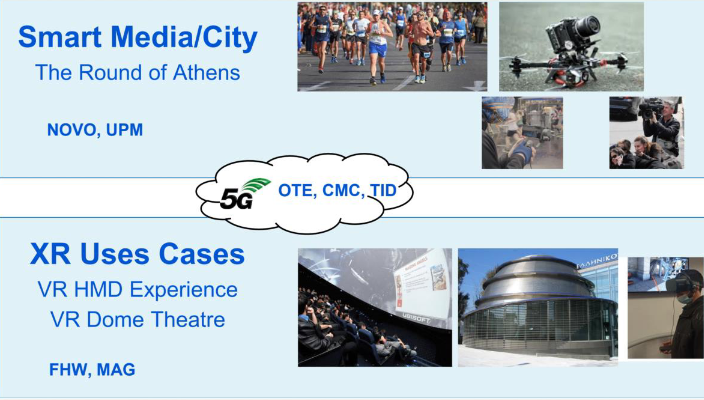
FHW as partner in the NEMO project, is tasked as Leader for the Task 5.5 Trial use cases that target Smart media, VR, XR. FHW supervises three Use cases.


1) The Smart City the round of Athens which will use the NEMO services for pushing the boundaries of live media capture and user participation to cover and present a live even such as the Athens Marathon.


2) The XR Use Case VR Dome Theatre which will use the NEMO services and AI/ML functionality to enhance the Tholos Dome shaped Virtual reality system of the Hellenic World with additional sensorial AIOT devices for Live user capture, enhancing the experience of the participants.


3) The XR Use Case HMD Experience which will user the NEMO services and AI/ML functionality to enhance an existing HMD experience with addition user bio feedback for having the experience adapt to the emotional and physical status of the participant.

Read More

Introducing the NEMO Project on GitLab

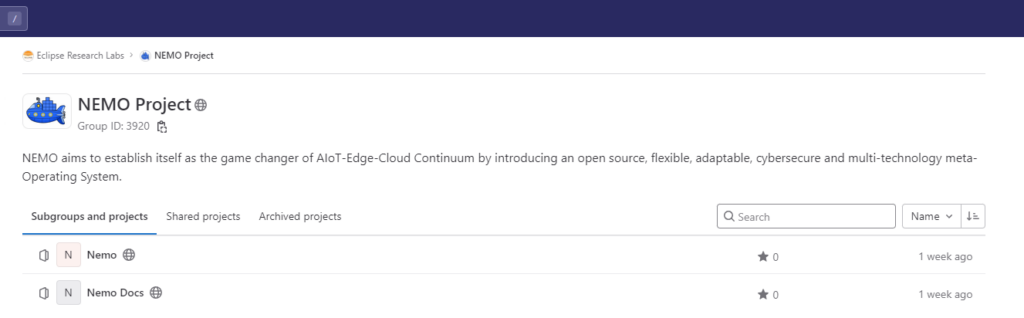
Now that the NEMO Project is on GitLab, they’re ready to welcome more contributors. They’ll work on building a collaborative community, improving code quality, and planning for the future. In the next phase of the NEMO Project’s journey on GitLab, the Work Package (WP) leaders are preparing to take action. They will begin uploading code related to each subcomponent of the project.

Check out the NEMO Project’s GitLab repository at https://gitlab.eclipse.org/eclipse-research-labs/nemo-project to join the adventure!

Read More

About Sorbonne University

Sorbonne University is a world-class academic institution that was created on January 1st, 2018, as a result of the merger of two first-class research-intensive universities, UPMC (University Pierre and Marie Curie) and Paris-Sorbonne. The university is multidisciplinary and research-intensive, with three faculties: humanities, medicine, and science. Each faculty has the autonomy necessary to conduct its ambitious programs in both research and education. Sorbonne University has a student population of 53,500, with 3,400 professor-researchers and 3,600 administrative and technical staff members.

LIP6 is a computer science laboratory that is jointly operated by Sorbonne University (SU) and the French National Center for Scientific Research (CNRS). The laboratory is internationally recognized as a leading research institute. The LIP6 Networks and Performance Analysis (NPA) group focuses on developing an autonomous, reliable, high-performance, and secure digital infrastructure for the future internet. LIP6 is involved in many activities related to advanced wireless, smart mobility, optimization, virtual networks and slicing, internet governance and regulation, monitoring, and large-scale EU-funded testbed projects such as PlanetLab Europe, Onelab, OpenLab, F-Interop, and Armour. The NPA group conducts research in networking through basic research and transfer activities in strong cooperation with worldwide academic partners and industrial leaders. Transfer is measurable through contributions to standardization bodies such as IETF: MLDv2 or RTP XR, the creation of start-ups, as well as numerous industrial contracts. The group activity is supported by permanent researchers, Post-Doc researchers, international visitors, engineers, and PhD students.

Role In the project

SU will provide access to the OneLab/SLICES testbed in Paris, which offers IoT/5G/B5G/6G infrastructure, including SDR/USRP devices, Kubernetes clusters, and over 2700 wireless static and mobile IoT nodes. Additionally, SU will contribute to the development of cybersecure federated deep reinforcement learning methods and techniques. These methods will securely combine local machine learning training to update a global model without compromising scalability, fault-tolerance, and security against poisoning attacks. Finally, SU will contribute to the monetization and consensus-based accountability of resources by leveraging interoperable blockchain ledgers to track provenance and enforce secure negotiation and transaction of resources.

Read More

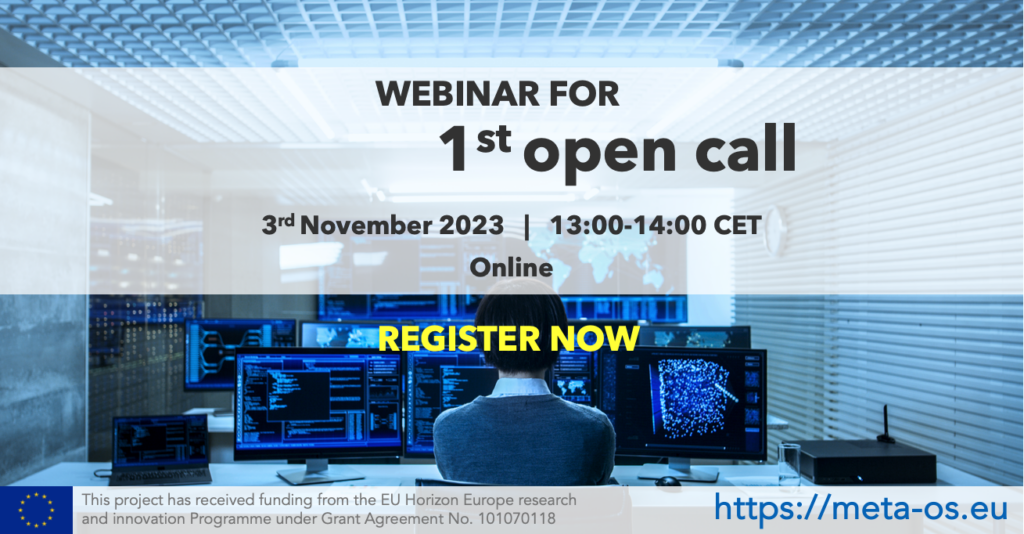
Open Call #1 Webinar

NEMO first open call for proposals is live! NEMO will host a webinar where you will have the chance to get information about the NEMO project with the view of joining us through the Open Call projects. The webinar will provide insights on the NEMO project and the 1st Open Call. Questions related to NEMO architecture and use cases will be answered.

AGENDA

13:00-13:25  NEMO Project presentation

13:25-13:40  OC1 topic and procedure

13:40-14:00  Q&A

WHY PARTICIPATE?

Explore opportunities to get funded through the NEMO Open Call #1

Gain insights on the unique NEMO approach to delivering the meta-OS for next-generation integrated IoT, edge and cloud computing

WHO CAN PARTICIPATE?

SMEs active in edge computing, edge and/or cloud native software development, operating systems, IoT/5G networks and IoT manufacturing entities are welcome to join this event.

Register Button

DETAILS

Date: November 3, 2023

Time: 13:00 – 14:00 CET

Venue: Online

Join us and learn more about the NEMO project towards your opportunity to get funded!

Read More

Nemo Project was present in ESAAM 2023

ESAAM 2023 was celebrated this week in Ludwigsburg, Germany. An incredible oportunity to get to know better all the projects sorrounding artificial intelligence, cloud edge computing and security.

During this one day event, NEMO Project was presented during the conference called “NEMO: Building the Next Generation Meta Operating System”. This lecture was done by Ioannis Chochliouros, from OTE, one of our partners.

The project was present in Eclipse’s booth were all visitors could learn more about the aspects of this innovative computing continuum.

Artificial Intelligence of Things (AIoT) is one of the next big concepts to support societal changes and economic growth, being one of the fastest growing ICT segments. A specific challenge is to leverage existing technology strengths to develop solutions that sustain the European industry and values. The ongoing ΝΕΜΟ (“Next Generation Meta-Operating System”) EU-funded project intends to establish itself as the “game changer” of the AIoT-Edge-Cloud continuum by introducing an open source, modular and cybersecure meta-operating system, leveraging on existing technologies and introducing novel concepts, methods, tools, testing and engagement campaigns. (https://dl.acm.org/doi/10.1145/3624486.3624504)

Here is the agenda of the event: https://events.eclipse.org/2023/esaam2023/#agenda

Read More

ASM

Established in 1960, ASM Terni S.p.A. stands as a prominent public utility, jointly owned by the Terni municipality and a consortium of private stakeholders. The company is active in diverse sectors, including electricity generation and distribution, maintenance and management of the gas network, environmental services, and water distribution. ASM Terni places a strong emphasis on ensuring uninterrupted service provision, the enhancement and modernization of vital infrastructure assets, and maintaining a proactive approach to meet the ever-evolving needs of its users.

ASM Terni owns and manages the local power distribution network in the City of Terni, which serves a population of 111,750 over an area of 211 square kilometres. Annually, the company supplies approximately 400 GWh of electricity to 65,000 customers. The distribution network sources electricity from the national transmission grid at a high voltage (HV) level, facilitated through three primary substations. Subsequently, electricity is supplied to residential and commercial customers through an intricate network of 60 medium voltage (MV) lines and 700 secondary substations.

Within the NEMO project, ASM plays a pivotal role as it leads Work Package 5 (WP5) i.e., NEMO Living Labs validation & 3rd party support. WP5 encompasses a spectrum of tasks, including the establishment and execution of the Living Lab validation process, along with providing essential support for third-party components and assets through the Open calls.

ASM also leads the task of smart energy & smart mobility validation. This task will realise the Smart Energy/Smart Mobility use cases. Emphasis will be put on Smart Grid Active Monitoring/Control at real-time using CF-DRL hosted locally on the IoT nodes (smart meters, substations, EV chargers), in the edge and at the cloud, deal with thousands of nodes using the digital twin concept and utilise advanced FML analytics to indicate that maintenance is required before performance degradation or even failure take pace. Moreover, the pilot will validate Smart Mobility scenarios experimenting with the DT concept, EV chargers, EV cars and analysis of physical (i.e. weather, noise, CCTV).

Read More