NEMO in AGROTICA 2024

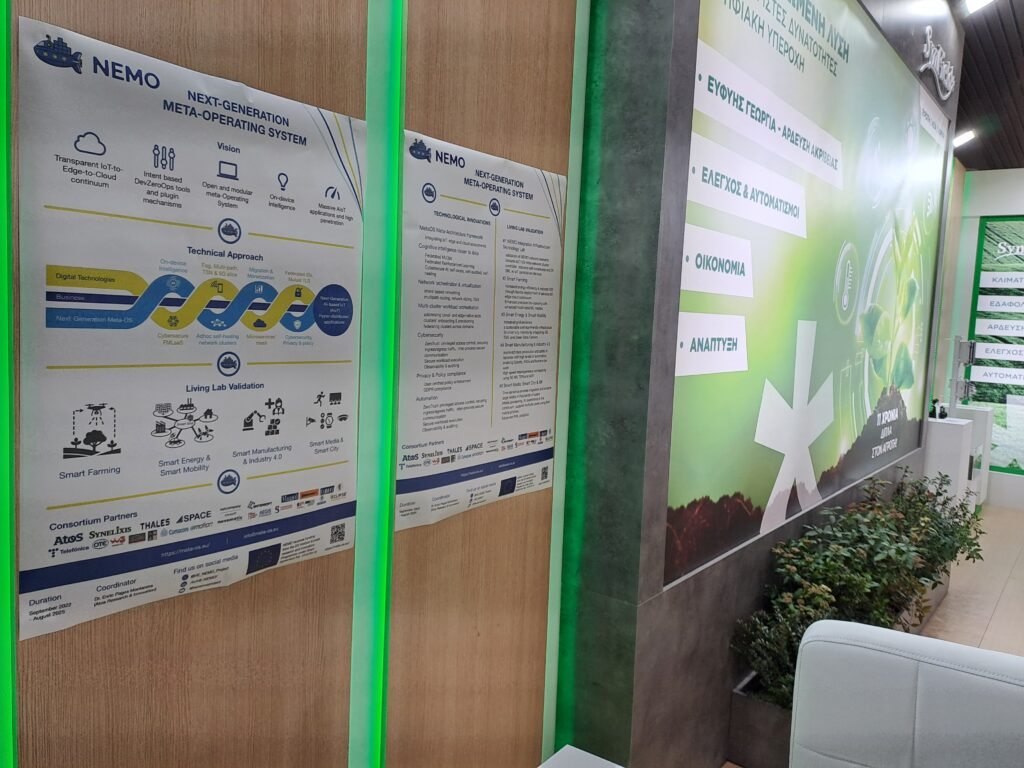
The NEMO project was presented by Synelixis at the 30th Anniversary International Exhibition of Agricultural Machinery and Equipment, AGROTICA 2024. The exhibition was held at the International Exhibition and Conference Centre of Thessaloniki, from the 1st to 4th of February 2024. Agrotica is the largest trade fair in the Southeastern Mediterranean, presenting the new trends and the global technology of the entire spectrum of agricultural entrepreneurship. 

In total 1,800 exhibitors from 49 countries participated in the event, while the cumulative attendance of visitors, from Greece and 17 foreign countries, exceeded 150 thousand people, creating thus a huge networking core for the primary production sector.

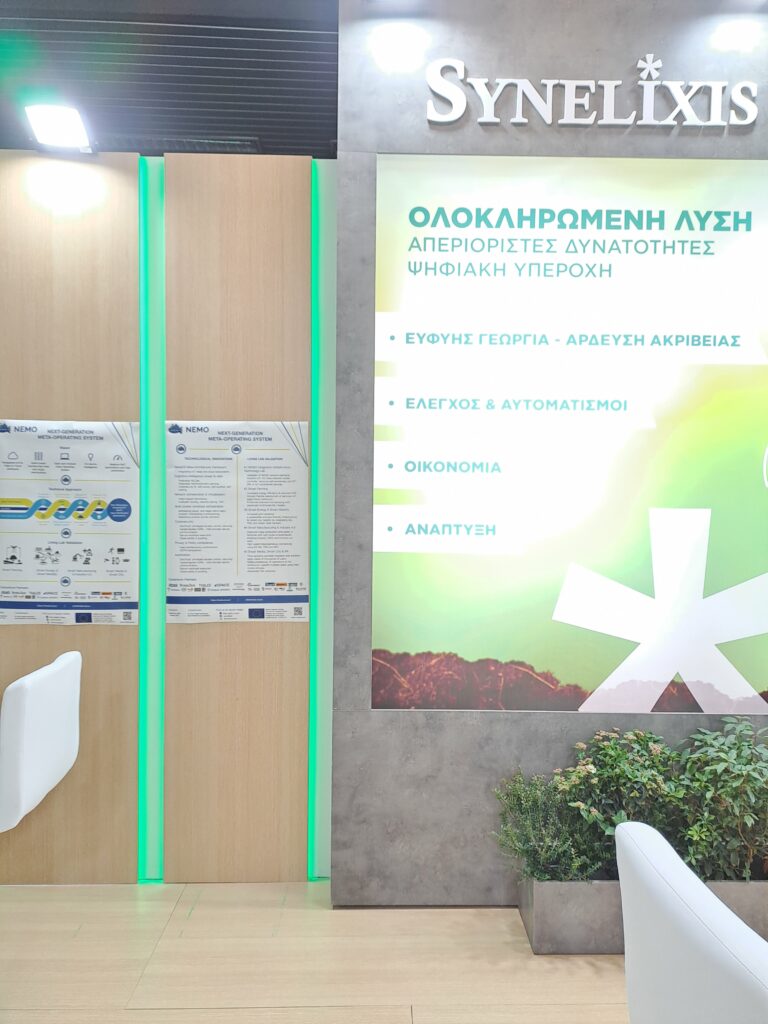
During the exhibition, we had the opportunity to inform visitors about the NEMO project in Synelixis’ stand and provide insights on the benefits brought by NEMO innovations in Smart Agriculture and precision farming. The audience showed significant interest on the energy efficiency and sustainability promoted by NEMO for Smart Agriculture operations, as well as ον the democratization of both resources and AI operations in Smart Farming business.

Within NEMO, Synelixis actively participates in the Smart Farming living lab, powered by Synelixis’ SynField, which is the company’s smart agriculture solution and has been presented at the exhibition. The pilot use cases aim to validate and demonstrate resource savings and yield increase through both aerial and terrestrial precision spraying in bio-certified olive groves. Thus, Synelixis experiments on extending its SynField platform, in order to support smart placement of services across the IoT-Edge-Cloud continuum, offering AI in the farm, while integrating with agri-drones and agro-robots.

Read More

NEMO Co-Organizes MECC 2024 Workshop at ACM EuroSys 2024

The 1st International Workshop on MetaOS for the Cloud-Edge-IoT Continuum (MECC 2024) is being co-organized by NEMO. This workshop will be held in conjunction with the esteemed ACM EuroSys 2024 conference, which will be held in Athens from April 22–25, 2024.

The goal of MECC 2024 is to give a thorough understanding of the opportunities and challenges that MetaOS presents when coordinating the Cloud-Edge-IoT ecosystem.

A range of technical talks, interactive sessions, and panel discussions will be included in the workshop, with an emphasis on important topics including standardization, interoperability, and the integration of MetaOS with pertinent open-source projects. In order to advance the field of MetaOS, participants will have the chance to collaborate on creative solutions, share ground-breaking research findings, and exchange ideas.

In order to contribute to the collaborative growth of MetaOS and its revolutionary influence on the Cloud-Edge-IoT continuum, NEMO invites researchers, academics, industry experts, and enthusiasts worldwide to participate in this ground-breaking workshop at ACM EuroSys 2024.

Topics of interest

  • Enablers, tools and mechanisms for MetaOS, services and applications
  • Latency, scalability, and connectivity issues in the continuum
  • Data protection, privacy, and defense mechanisms against emerging threats
  • Solutions and algorithms for distributed processing at the edge
  • Real-time decision making and AI models based on heterogeneous data
  • Practical applications of MetaOS in various industries, e.g., healthcare, smart cities, and industrial automation
  • AI/ML for resource allocation and predictive maintenance
  • Service and network orchestration in the continuum
  • Serverless computing and Function-as-a-Service in the MetaOS
  • Energy efficiency and resource optimization by exploiting MetaOS benefits
  • Multi-tenancy at the edge of the network
  • Open Hardware and Software solutions for the MetaOS
  • Novel solutions for a transparent service migration across (far) regions
  • Business models for a multi-stakeholder MetaOS-based computing continuum

Important Dates

Workshop Paper Submission: February 11, 2024
Workshop Notification of Acceptance: February 25, 2024
Camera-ready Submission: March 15, 2024
Workshop Date: April 22, 22024

More information can be found in the workshop call for papers.

Read More

OC#1

NEMO announces Open Call #1, which aims to extend NEMO scope and technology. NEMO is delighted to announce the Open Call #1 winning proposals, which aim to extend NEMO scope and technology.

  • MetaFOX,by Vodéna, Serbia which will work on Machine Learning and AI technologies

  • CorMOS,by Business & IoT Integrated Solutions ltd, Cyprus which focus relates to cross-domain orchestration of Meta-OS edge resources.

  • ARGO,by Intellia ICT, Greece, which will focus on AR/XR technologies

  • Eros4NRG,by Martel Innovate BV, Netherlands which will offer Zero Trust IoT Analytics with focus on Smart Energy applications.,

  • GENESYS,by SWHARD srl, Italy which will provide Edge Gateway for NEMO Meta-OS.

  • MARINEMO,by BEAM Innovation, Romania which will work on Efficient Resource Utilization and Maritime Network Slicing Plugin for NEMO Meta-OS

Read More

Eclipse Foundation

The Eclipse Foundation provides our global community of individuals and organizations with a mature, scalable, and business-friendly environment for open source software collaboration and innovation. The Foundation is home to the Eclipse IDE, Jakarta EE, and over 430 open source projects, including runtimes, tools, and frameworks for cloud and edge applications, IoT, AI, automotive, systems engineering, distributed ledger technologies, open processor designs, and many others. The Eclipse Foundation is an international non-profit association supported by over 330 members, including industry leaders who value open source as a key enabler for their business strategies.

The Eclipse Foundation has 10 years involvement in EU research programs. We help organizations to successfully create, publish, and sustain their open source software platform, making the results of the research projects available for commercial or public exploitation.In the NEMO project, Eclipse leads the “Liaison with Clusters, Open Source communities & standardization” task, focusing on several key responsibilities:

  • Eclipse serves as the hosting platform (Eclipse Research Labs) for the project’s open-source code. It ensures that the consortium members collaborate openly and govern the code effectively, adhering to established open-source best practices and principles.
  • It facilitates access to the broader Eclipse ecosystem, specifically focusing on the Cloud to Edge to IoT domain. This access enables communication and dissemination of the NEMO project’s vision and outcomes to developer communities operating within these domains.
  • Eclipse takes steps to prepare the project’s code for review under Eclipse’s Intellectual Property (IP) guidelines. This includes:
    • License Selection: Choosing a business-friendly license that aligns with the project’s objectives while ensuring compatibility with open-source principles.
    • Copyright Compliance: Defining and completing copyright headers for the code to establish ownership and clarify licensing terms.
    • Third-Party Dependency Verification: Ensuring that dependencies used within the codebase comply with licensing requirements and are compatible with the chosen license for the project.

    In addition to its role within the NEMO project, Eclipse’s partnership with CSA EUCloudEdgeIoT.eu further expands its involvement within the MetaOS call projects.

    • It serves as a partner within CSA EUCloudEdgeIoT.eu, which broadens the NEMO project’s perspective on the MetaOS call projects. This partnership provides the NEMO project with a more comprehensive and global view, enabling it to understand and engage with a wider network of initiatives related to MetaOS.
    • It aims to facilitate collaboration among various projects involved in the MetaOS call. Its overarching goal is to foster cooperation and synergy among these projects, with a particular focus on defining a unified and shared open-source stack.
    • Last not least, Eclipse’s vision involves assisting these MetaOS call projects in working collaboratively. The emphasis is on establishing a common open-source stack that can be leveraged and shared among these projects. This joint effort aims to streamline development, enhance interoperability, and promote a cohesive ecosystem within the MetaOS framework.
Read More

AEGIS

AEGIS IT RESEARCH GmbH is a research and development company (SME) based in Germany developing and managing innovative IT solutions for numerous business sectors. It is based on a highly effective professional team consisting of talented researchers and top-class IT experts from all over the world. This team empowers the company with a strong, diverse skill set which helps AEGIS offer innovative products and high-tech business solutions to the market.

AEGIS has a long-term involvement in the entire lifecycle development of cybersecurity, criminal investigation and data management and visualisation solutions, through both research and innovation driven initiatives and commercial projects. The main area of expertise is on providing tools and services in the field of cybersecurity, including digital forensic analysis and investigations, adaptive data visualization systems, access control and network security systems, and privacy preserving systems, and the complete lifecycle of IT systems (design, development, deployment, optimisation and maintenance).

In the context of NEMO project AEGIS is leading T4.1 Plugin & Applications Life-Cycle Manager, a mechanism for plugins and applications life cycle management across the NEMO ecosystem. AEGIS will provide the interface to NEMO end-users to register, deploy and manage workloads and monitor events and security incidents.

Read More

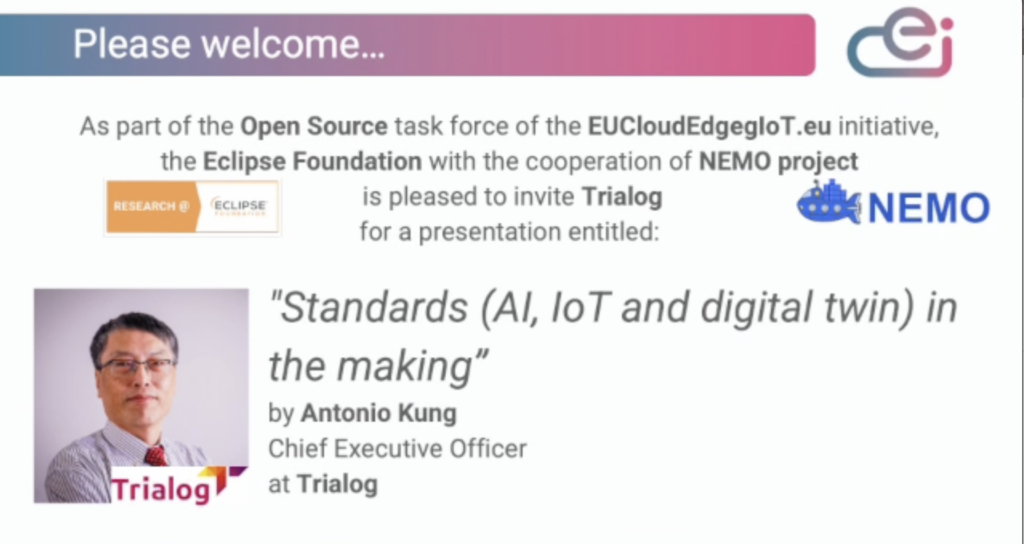
NEMO project at the webinar “Standards (AI, IoT and digital twin) in the making”

Antonio Kung is co-founder of Trialog. With more than 30 years of experience in the field of cyber physical systems and the Internet of Things, he brings expertise and know-how particularly on architecture, interoperability or data security and protection.
He presented a talk with the title “Standards (AI, IoT and digital twin) in the making”, the webinar provided useful insight on work in standardisation taking ISO as an example, the process of proposing and developing a standard as well as giving advice on how to participate.

The talk touched important aspects of the standards in the making, starting with the Standardization Process. On this aspect, Antonio Kung presented an example on how you can get involved, starting from registration to the national standardization body, step by step through the necessary actions with focus on the European regulation and AI act.

After the introduction the talk has focused on the Standards in the making with respect to architecture. In this context, examples on IoT, digital twin and Cloud reference architecture have been made. Finally the roadmap about the evolution of the reference architecture has been presented along with the detailed mapping between standards and topics. Trustworthiness is concerning standards and it is defined as the verification of the stakeholder’s expectations. On this view, the related projects, NEMO amongst them, have been shown and presented in relation to the trustworthiness.

Furthermore, data and data space standards overview have been presented as well as interoperability and integration between data, information and knowledge. A cybersecurity evaluation of complex systems referring to ISO/IEC TS 27115 has been discussed in the implementation of the reference architecture level.

Finally, integration issues and a vision and roadmap for a reference architecture for the computing continuum has been presented. A fruitful discussion with the audience concluded the webinar.

Read More

Smart Energy Living Lab in Terni

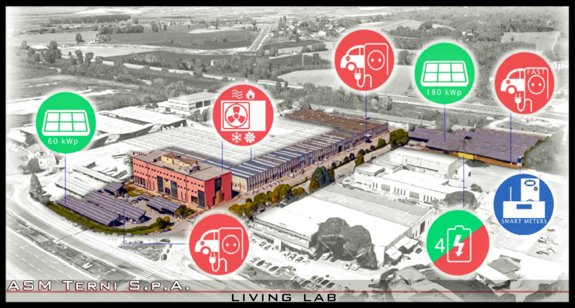
The Smart Energy Living Lab in Terni stands as a beacon of innovation, providing an ideal platform for the exploration and showcasing of cutting-edge technologies and models in the realm of smart energy. In an era where decentralized renewable energy sources pose both opportunities and challenges to the existing distribution network, the Living Lab serves as a real-world testing ground. By replicating actual operating conditions, the Living Lab not only addresses the practical challenges of decentralized energy generation but also plays a crucial role in shaping the future of the energy landscape, paving the way for sustainable and efficient models to thrive in the market.

The living lab of ASM headquarters district includes two substations, a distribution feeder network branch comprising decentralized RES generation (240 kW peak power PVs), controllable loads (via Building Energy Management System), HVAC (around 100-120 kW), and three EV charging stations (two at 22 kW and one at 50 kW). Additionally, there’s a biodiesel cogenerator and a hybrid power grid handling both direct and alternating current, currently in the construction phase.

The living lab also includes a total of 150 near real-time IoT smart meters deployed in multi-apartment residential buildings, public schools equipped with PV local generation, and households with residential consumers equipped with PV. Ten IoT analyzers have been deployed in the secondary stations to monitor electric parameters. These are three-phase power meters capable of measuring current, voltage, and power on up to four electric lines connected to the same node. Data are transmitted via ethernet or 4G to the LV SCADA.

A state-of-the-art Scalable SCADA System has been integrated with part of the LV network to monitor data from sensors and IoT devices deployed throughout the grid. This real-time platform ensures reliable grid performance and allows for continuous enhancements in visibility. One of the standout features is its openness, allowing other software experts to create customized apps that can seamlessly connect different types of technology without causing problems. This helps make operations smoother and more efficient while improving the visibility of the grid. The System Platform is a versatile and collaborative tool that streamlines operations, promotes continuous improvement, and is able to communicate with every device or back-end system by using standard interfaces such as OPCUA, OPC DA, SQL, SOAP, HTTP/S, .NET.

Read More

Navigating the Future: Understanding the New European Law on Artificial Intelligence

The trajectory of technological advancements has established a lanmark after the European Union has introduced a comprehensive legal framework addressing the complex space of Artificial Intelligence (AI). A European Law of Artificial Intelligence has been published. This legislation, recently approved by the European Parliament, stands as an evidence to the EU’s commitment to both fostering innovation and safeguarding fundamental rights. The key aspects of this groundbreaking law looks to provide precise definitions of AI systems, categorizing them into three levels of risk: Unacceptable Risk, High Risk, and Low to Minimal Risk. This granularity aims to create a nuanced approach tailored to the potential societal impacts of different AI applications.

Also, this means that for AI systems deemed of high risk, such as those employed in critical infrastructure, healthcare, and law enforcement, the law mandates stringent requirements. These include thorough risk assessments, data quality and traceability, robustness and accuracy, human oversight, transparency, and the provision of clear user information.

Certain AI applications will be considered as to be of “unacceptable risk” and will be outright prohibited. These include systems designed to manipulate human behavior, exploit vulnerabilities, and those posing a clear threat to safety. Non-compliance with the regulations can result in substantial fines, underscoring the seriousness with which the EU takes these matters.

Protecting Fundamental Rights

The legislation emphasizes the protection of fundamental rights, ensuring that AI systems adhere to principles such as human dignity, non-discrimination, and fairness. It sets the stage for responsible and ethical AI development, emphasizing the need to avoid biases and discriminatory practices.

To enforce these regulations effectively, the legislation proposes the establishment of a European Artificial Intelligence Board. This will be an independent body that will oversee compliance, provide guidance, and facilitate cooperation among Member States.

The EU acknowledges the future role of AI as a driver for innovation and economic growth. The legislation seeks to create an environment where European businesses can thrive in the global AI landscape. So this regulation aims to set a standard for responsible AI development and deployment, it also looks to contribute to shaping international norms and practices in the field.

As Europe takes this bold step into the future, the new law on Artificial Intelligence reflects a delicate balance between encouraging innovation and safeguarding the values and rights that underpin our societies. It sets the stage for a responsible, ethical, and accountable approach to AI, with the potential to shape the global discourse on the development and deployment of artificial intelligence.

https://www.europarl.europa.eu/news/en/headlines/society/20230601STO93804/eu-ai-act-first-regulation-on-artificial-intelligence

Read More

The Data Governance Act entered into application September 2023

The regulation included in the Data Governance Act creates a new European way of data governance based on increasing trust in data sharing. This will bring significant benefits for both companies and citizens.

The benefits of the application of this act are broad and affect all strategic sectors of the economy, such as energy, health, environment, agriculture, mobility, finance, manufacturing, public administration and skills.

The initiative aims to make more data available and facilitate data sharing across sectors and EU countries in order to leverage the potential of data for the benefit of European citizens and businesses.

This will enable industries to develop innovative products and services, making them more efficient and sustainable. Also, it will be key for training AI systems.

As for the public sector this data availability will permit the development of better policies, leading to more transparent governance and more efficient public services.

Actually, the Data Governance was established already on 23 June 2022, but it had a 15-month grace period that ended last September 2023. To conclude, it will be a powerful engine for innovation and it will create new job opportunities.

More information here: https://mobispaces.eu/data-governance-act


Read More

GPU Acceleration in Unikernels Using Cricket GPU Virtualization

The partners of NEMO project have achieved a publication regarding GPU acceleration.

Today, large compute clusters increasingly move towards heterogeneous architectures by employing accelerators, such as GPUs, to realize ever-increasing performance. To achieve maximum performance on these architectures, applications have to be tailored to the available hardware by using special APIs to interact with the hardware resources, such as the CUDA APIs for NVIDIA GPUs. Simultaneously, unikernels emerge as a solution for the increasing overhead introduced by the complexity of modern operating systems and their inability to optimize for specific application profiles. Unikernels allow for better static code checking and enable optimizations impossible with monolithic kernels, yielding more robust and faster programs. Despite this, there is a lack of support for using GPUs in unikernels. Due to the proprietary nature of the CUDA APIs, direct support for interacting with NVIDIA GPUs from unikernels is infeasible, resulting in applications requiring GPUs being unsuitable for deployment in unikernels.

We propose using Cricket GPU virtualization to introduce GPU support to the unikernels RustyHermit and Unikraft. To interface with Cricket, we implement a generic library for using ONC RPCs in Rust. With Cricket and our RPC library, unikernels become able to use GPU resources, even when they are installed in remote machines. This way, we enable the use of unikernels for applications that require the high parallel performance of GPUs to achieve manageable execution times.

You can read more: https://dl.acm.org/doi/10.1145/3624062.3624236

Read More